Blog
/
Vercel swapped 10 SDRs for a $1,000/year AI agent. Learn why I stopped hiring salespeople and started hiring GTM Engineers to scale.
How many employees does it take to grow revenue from $100 million to $200 million ARR in a highly competitive market?
The answer used to be "an army." Turns out, today it is 1 AI Engineer (with the title of GTM Engineer) who replaced 10 SDRs.
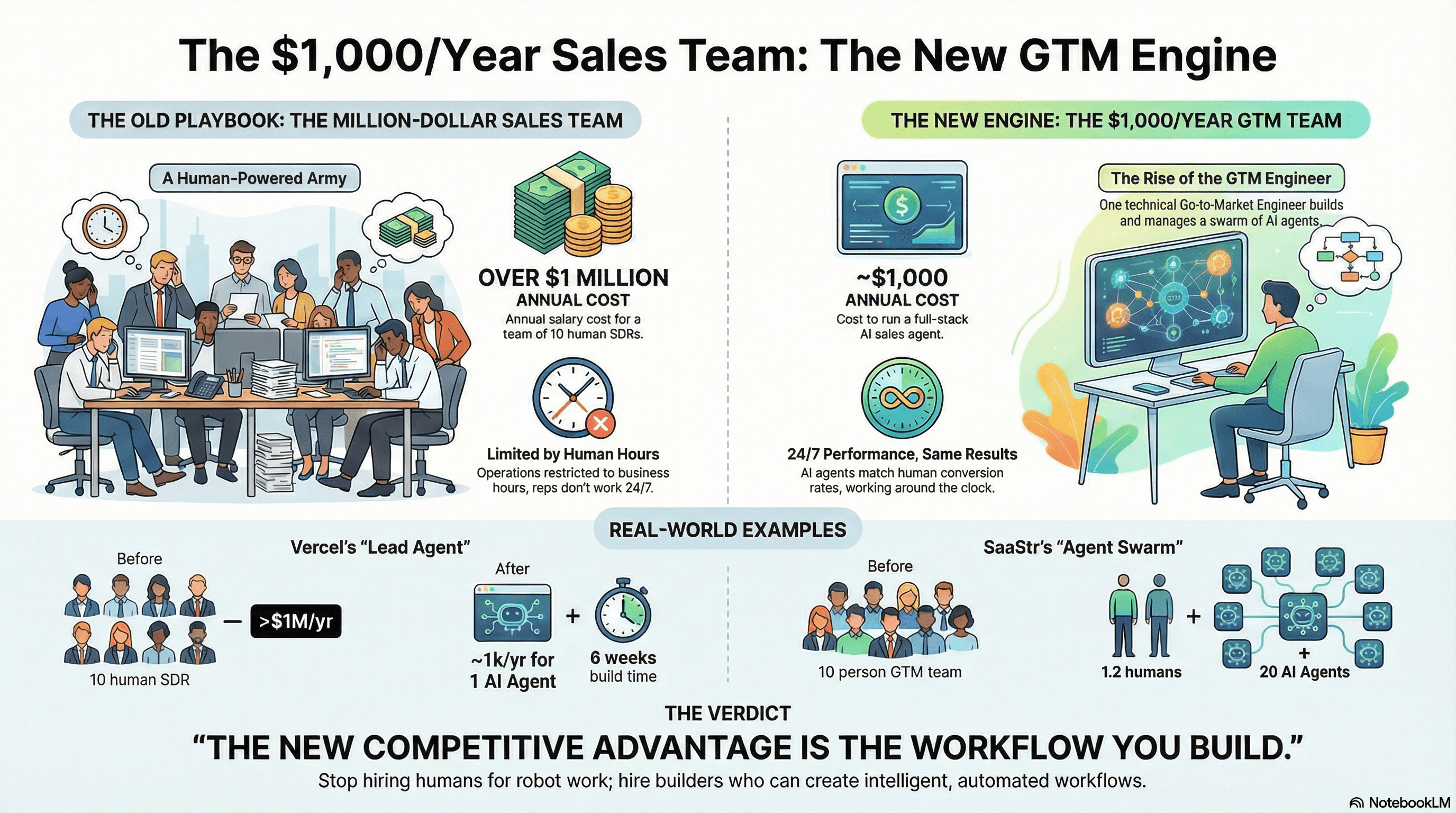
Jeanne DeWitt Grosser, the COO of Vercel, recently revealed how the company is managing its explosive growth. To handle their massive inbound demand, they didn't hire an army. They built a "Lead Agent." In a move that signals the end of an era for traditional sales, Vercel transformed a function that previously required 10 people and cost well over $1 million a year into a single human manager and one AI agent. The cost to run that full-stack AI agent on Vercel’s infrastructure is approximately $1,000 per year.
This wasn't a multi-year R&D project run by a massive team. It was built by a single "GTM Engineer"—a former Sales Engineer with a Computer Science degree—who coded the solution in just six weeks while working only part-time on the project. The result is an agent that maintains the same lead-to-opportunity conversion rate as humans, but drastically reduces time-to-convert because the agent never sleeps, never takes a holiday, and responds instantly.

The Shift: They transformed a function requiring 10 Inbound SDRs into a single human (acting as a QA manager) and 1 Lead Agent.
The Cost: The human cost was well over 1 millionper/year. The cost to run the full−stack AI agent on Vercel’s infrastructure? 1,000 per year.
The Speed: This wasn't a multi-year R&D project. It was built by a single GTM Engineer—a former Sales Engineer with a CS degree—in just 6 weeks, working only part-time on the code
This revelation validated a difficult realization I had regarding my own business, Ausbiz Consulting. As we pivoted our focus from broad app development to exclusively building Agentic AI solutions for the mid-market and high-growth startups, I initially attempted to scale our sales organization the traditional way. I posted job openings for Sales, Marketing, and "Growth Leads."
What I received in return was a replay of old-school tactics—strategies that are simply no longer sustainable for a bootstrapped company trying to thrive in 2025. My research indicated that the "modern" sales stack has collapsed. Mainstream apps like Apollo, Clay, and Instantly have adopted agentic capabilities so quickly that there is very little differentiation left in the SaaS tools themselves. The competitive advantage has shifted entirely from the tool you buy to the workflow you build.
Consequently, I conceded that the old hiring playbook was broken. We narrowed our company focus to a specific set of high-value problems—such as voice agents for sales or customer service—and realized that to sell these modern solutions, we couldn't use archaic methods. We didn't need "salespeople" in the traditional sense; we needed builders.
For business leaders who exist outside the Silicon Valley "growth hacking" bubble, the terminology used by companies like Vercel and SaaStr can sound like alphabet soup. However, understanding three specific terms—GTM, SDR, and AE—is critical to understanding why AI is rapidly replacing human headcount.
The most vulnerable role today is the SDR, or Sales Development Representative. Historically, this has been a junior employee, often fresh out of college, whose sole job is to "hunt." They answer "Contact Us" forms (inbound) or send hundreds of cold emails (outbound) to book meetings for senior staff. They don't close deals; they just open doors.
This role is facing extinction. As Jason Lemkin, founder of SaaStr, bluntly puts it, he can no longer justify paying a junior SDR $150,000 a year for them to quit after a few months. Instead, companies are deploying "Lead Agents"—AI that instantly researches a prospect, checks their tech stack, and drafts a highly personalized reply in seconds.
The second role is the AE, or Account Executive. These are the "closers"—the senior salespeople who take the meetings booked by the SDRs, negotiate pricing, navigate procurement, and sign the contract. While AI isn't replacing the AE entirely, it is turning them into cyborgs. At SaaStr, Jason Lemkin transformed a team of ten full-time staff into what he calls "1.2 humans" and 20 AI agents. That "1.2 humans" consists of one Account Executive and a "Chief AI Officer" who orchestrates the agents. This lean team generates the same net productivity as the previous ten-person team.
Finally, there is GTM, or Go-to-Market. In the old world, this just meant "Sales and Marketing." Today, leaders like Jeanne at Vercel define it as any function that touches a customer to make a dollar—including Success, Partnerships, and Support. In an AI-native company, these aren't silos; they are one continuous workflow where data flows seamlessly from a marketing email to a support ticket without human friction.
If the SDR is dying, the GTM Engineer is rising to take their place. This is a new breed of professional who sits within the revenue team but possesses the technical skills of a software engineer. Instead of making phone calls, they write code to automate the sales process.
Vercel is a compelling case study for the "Build" model of GTM Engineering. As a deep-tech company, they follow the philosophy of "Vercel builds Vercel." Their GTM Engineers shadow top sales performers, deconstruct their cognitive workflows—such as how they research a company or deciding which tab to click next—and encode that logic into software.
They even built an internal agent called "Dealbot." This agent reads every email, Slack message, and call transcript associated with a sales deal. In one instance, it analyzed a lost deal and flagged that the loss wasn't due to price, as the human rep claimed, but because the rep failed to contact the "Economic Buyer," or the person with the budget. This is the kind of insight that previously required a human manager hours of review to catch, yet the AI did it instantly.
However, you don't have to be a multi-billion-dollar engineering company like Vercel to do this. Jason Lemkin at SaaStr offers a different path: Orchestration.
Jason advises that unless you have Vercel’s engineering resources, you shouldn't build the agents from scratch. Instead, you should orchestrate a "swarm" of vendors. He envisions a future of "Swarm Coding," similar to what we see in platforms like Replit, where AI agents debate other AI agents to solve problems without human intervention.
SaaStr uses specific agents for specific jobs. They use an agent called "Qualified" to handle inbound traffic on their website and an agent called "Artisan" for outbound emails. These agents are relentless. Jason noted that they are closing sponsorship deals at 11:00 PM on Saturdays—a time when no human representative would ever be online. They even deployed Salesforce’s "Agentforce" to reactivate "dead" leads that human reps ignored because the commission wasn't worth the effort. The result was a stunning 70% response rate from previously considered waste leads.
The era of hiring humans to do robot work is over. Countless companies are transforming their existing sales organizations, while many smaller high-growth companies are completely doing away with hiring traditional sales roles entirely.
If you are looking to transform your business or rebuild a unit from scratch, do not hire entry-level sales reps to act as human routers for emails. The math no longer works. You must hire GTM Engineers—builders who can use workflows and orchestrate agent swarms. The future of the AI-native company is not defined by how many people you have in seats, but by the velocity of your workflow and the intelligence of your agents.