Blog
/
GitHub Copilot Agent Skills launched! Build Next.js RAG chatbots without outdated code. 5 production-tested skills now available. Try it today.
GitHub Copilot's Agent Skills launched two days ago (December 18, 2025). I've spent the last three months building the exact skills I wish I'd had: battle-tested expertise for Next.js RAG chatbots that stops AI assistants from sabotaging you with outdated code. No more token-wasting doc fetches. No more context window collapses. No more nudging Claude to "please follow the instructions." Just drop these into .claude/skills/ and watch your AI finally understand modern frameworks.
The repository is live now: github.com/gocallum/nextjs16-agent-skills
Skills.md files are fundamentally changing what AI assistants can accomplish—transforming them from knowledgeable generalists into specialized experts that deploy deep domain knowledge at exactly the right moment. In a world where GitHub Copilot and Cursor now write the majority of our code, this isn't just another incremental improvement. It's a paradigm shift that solves the core limitation holding back AI-assisted development, especially when working with cutting-edge tools that even the most advanced models barely understand.
To understand why this matters, let's look at how we got here. Over the past year, tools like GitHub Copilot and Cursor have evolved from simple autocomplete to full-fledged pair programmers. It started with MCP (Model Context Protocol) and tool calling—a breakthrough that let our AI agents fetch real-time information from the web, connect to databases, execute code, and interact with external services directly within our IDEs. Suddenly, AI wasn't limited to its training data; it could access live documentation, run tests, and debug issues without leaving the chat interface.
Then came the standardization of agents.md files—instruction documents that helped AI understand our codebase, follow our conventions, and align with our project goals. In Cursor, these became "rules" that guide every code generation. In GitHub Copilot, they shaped how the AI interpreted our intent. By providing clear guidelines, we taught AI assistants to write code that matched our patterns, dramatically improving their output quality.
These two innovations have been game-changers. They've transformed AI from a simple autocomplete tool into a genuine development partner that can scaffold entire features, refactor sprawling codebases, and debug complex issues.
For months, I was locked in a vicious cycle while building production RAG systems and chatbots. My workflow had become a patchwork of inefficiencies: a bloated agents.md file, fragmented markdown documents in a /docs folder that I'd manually link for the AI to fetch, and an ever-growing .vscode/mcp.json config. It was exhausting. I'd spend more time managing my AI's knowledge than actually building—constantly telling it to "fetch this doc" or "read that guide," only to watch it skip steps, hallucinate patterns, or forget everything when I started a new conversation. When the context window filled up, generation became sloppy and unreliable. The promise of AI-assisted development had become a maintenance nightmare.
The breaking point came in December 2025 when React Server Component vulnerabilities (CVE-2025-55183, CVE-2025-55184) forced me to upgrade dozens of projects to Next.js 16.1 overnight. I had meticulously documented the migration steps—every breaking change, every new pattern—in a massive instruction file that I tried to apply across all projects. But the process was brutally inefficient:
Despite having all the documentation available, my AI assistants—even Claude Opus 4.5—kept reverting to Next.js 15 patterns that were completely incompatible. The AI would hallucinate old APIs, suggest deprecated configurations, and completely miss the async request API changes that were critical to the upgrade.
That's when it hit me: this is a fundamentally different problem than traditional framework churn. When you're building AI solutions, the ecosystem doesn't just evolve—it explodes. There's nearly a new framework or breaking change every few days. Vercel's AI SDK is the perfect example: version 6 beta is a complete rewrite to support agent development and workflows, and it landed just months after version 5—which itself was a massive breaking change from v4. Layer on top the constant model API changes, new providers like Groq Cloud revolutionizing open-weight models, and vector database innovations, and you have an environment where even the most powerful coding models can't help but generate outdated code. I was spending more time debugging AI-generated code that should have worked than actually implementing the upgrade.
What I discovered was the Agent Skills architecture—and just in time, too. Two days ago, on December 18, 2025, GitHub Copilot officially released Agent Skills support (changelog). Instead of fragmented docs or bloated instruction files, I created modular, load-on-demand expertise packages that activate automatically:
This wasn't just a personal workaround anymore—it had become the official path forward. GitHub Copilot now picks up skills from the .claude/skills/ directory automatically in VS Code Insiders (stable release coming early January), works across Copilot CLI, and integrates seamlessly with the coding agent. What started as my desperate attempt to stop AI assistants from sabotaging my RAG projects had become the solution the entire ecosystem needed.
The official GitHub Copilot location is .github/skills/, but I deliberately chose .claude/skills/ for maximum compatibility. This single location works across:
1: Open Github Copilot Settings (⚙️)
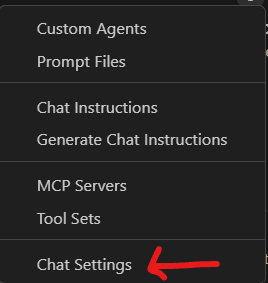
2: Click on Chat Settings
3: Activate Chat: Use Agent Skills (Experimental)
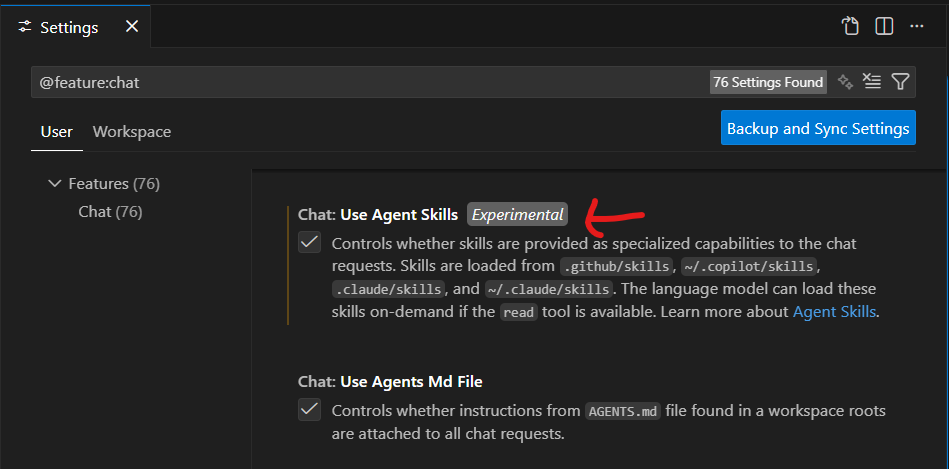
This means one skills repository works across your entire toolchain, whether you're in VS Code Insiders with GitHub Copilot, Claude Code's terminal, or Cursor's editor. No duplication, no maintenance nightmares—just expertise that follows you everywhere.
The github.com/gocallum/nextjs16-agent-skills repository contains five production-tested skills specifically designed for RAG and chatbot development:
Everything you need for chatbot interfaces: ToolLoopAgent patterns, workflow automation, streaming UI components, generative UIs, and context management strategies. This eliminated 90% of my architecture mistakes.
This skill finally stopped Claude from generating AI SDK v3 code. It covers agents, tool approval, structured output, reranking, Groq provider integration, and Vercel AI Gateway setup—essential because most LLMs were trained before AI SDK 6 existed.
After React's security issues forced urgent upgrades to Next.js 16.1, this became critical. It covers async request APIs, Turbopack bundler, and breaking changes that confuse every AI assistant still trained on v15.
Claude's most consistent failure: suggesting Prisma v6's CommonJS syntax. This skill forces ESM-only patterns, driver adapters, and proper prisma.config.ts usage.
For RAG applications: semantic search, namespace isolation for multi-tenancy, and MixBread embedding models—patterns too new for most training data.
Here's what I need from you:
This repository started as my personal frustration with building RAG systems. It can become something much bigger: a collective intelligence library that makes every AI assistant smarter for every developer.
Let's build it together.
Start here: github.com/gocallum/nextjs16-agent-skills
Use it: Add skills to .claude/skills/ and watch your AI assistant stop sabotaging you
Collaborate: Every issue, every PR, every suggestion makes this better for everyone
What did Claude get wrong today? What skill would have fixed it? Let's build it.